VASSILIKI

Vassiliki Benopoulou — Athens, 1960

Biography

Visual artist and sculptor, internationally renowned for her enormous kinetic installations. An interdisciplinary mind moving from literature and philosophy to monumental sculpture — a continuous polyptych on man and the divine.

Biographical Note

VASSILIKI (Vassiliki Benopoulou), born in Athens in 1960, is a visual artist and sculptor internationally renowned for her enormous kinetic installations as well as for her conjectural interventions. Exceptionally talented and motivated, is an artist with interdisciplinary academic background. She studied Greek, English and American Literature at the Kapodistrian University of Athens, Fine Arts at the American University of La Verne and the International School of Arts in Italy. Nicolas Carone was the professor who inspired and encouraged her mostly while Pierre Restany became her mentor and supporter during a critical period of her artistic career. Philosophy and every aspect of Theosophy developed by man throughout the centuries have been the passionate interests of her study and research. The philosophy that has been imprinted on her art is defined by the artist herself with the latin word “Divinitas”, especially on her paintings and sculptures of her first creative period (1976–1996) which represents a conceptual adaptation of the divine in the human intellect and emotional impact.

The divine of the human nature and the psyche, as defined by the Greek philosopher Aristotle, have played an exceptional role in Vassiliki’s idea of human integration within the framework of a philosophical and spiritual code and not of a religious one. It continued to play a prominent role even in the creation of her immense kinetic installations. The idealistic inner beauty and harmony of the human beings is Vassiliki’s reality. The negative personal and universal incidents of life make her turn into utopia quite often, creating her own vision towards the world, embracing every aspect of life with the strongest belief in the victory of the positive inner powers over the negative ones. She dares standing up towards the catastrophes, the conflicts, and the contradictions, experiencing them as the only way of self development.

In her paintings as well as in her installations, Vassiliki has documented the productive dialogue between art and life through everlasting cultural and spiritual figures and symbols. Her work as a whole is defined by coherent, autonomous thematic evolutionary units, and it forms a creative polyptich, which reflects genuine existential awakenings and a philosophical contemplation on man and the divine.

Profoundly homocentric Vassiliki’s art signifies the continuation of a route dedicated to the mystery of existence through symbolism. In the devout environment of her installations-environments which extend to areas of over 3.000 square meters, she combines her artistic proposal with the everlasting concern of inner balance, and man’s position in the universal whole. Man’s ultimate goal, as it is expressed through the dynamics of her sculptures, is the struggle which aims at accomplishing the unity of all conflicting powers.

Daring and concerned, Vassiliki continues her speculation and pursuits of the transformation of the image revealing the new interpretation of her work consisting of elements from Commedia dell’ Arte (The City of Games 2000). The mystagogy of self-knowledge was and remains to be the most important aim of Vassiliki’s art. In her first monumental installations the artist has been working with the mirror on cross-shaped sculptures discrediting or entrapping the fragmented idol’s representation while giving priority to frugality and clarity of sculptural expression. An artist of a rare intellectual sensibility, Vassiliki combines a strong motivation for advancement and progress with high professionalism and a constant search for perfection with thoroughness, while implementing her energetic temperament in order to innovate.

Her installation The City of Games (2000), is considered to be one of the biggest in scale installations, composed by two thousand sculptures, all painted by hand with an astonishing geometrical, almost compulsive, accuracy, a plethora of colors, shapes and endless arabesques flying into the air and outlined by the figures of Dancers, Acrobats, Guards and the Harlequins —the dominant figure of the City— through swings, the wheel, balls and other machine-made and kinetic devices. Following the inspired “Stavroschimites” (1997), referring to the form of virtue through its embodiment in the human figure, Harlequins emerge as a key symbol of the artist’s approach toward life, death and the divine through the creation of her ideal beings. The characteristic multi-colored diamond shape costume of Harlequin, the protagonist of Commedia dell’ Arte, is the primary motif of The City of Games.

A magestic «stage» with all the necessary paraphernalia promising the trip to the magic world of imagination through the unknown, behind which lurks the danger of balance, the City of Games is an independent, integrated and self-sufficient environment. It carries along its visitors due to the grandness of its extension and the indescribable game of the senses. Dressing up its surroundings, the diamond shape evolves into an enigmatic game of colour combinations that is based on the optical experience and perception.

The “Temple of colors” is certainly the biggest three-dimensional painting in the history of contemporary art so far, covering a surface of 2.000 square meters, all painted by hand. The color tones, the combinations as well as the diamond shapes are almost never perceived to be the same. This differentiated optical perception is due to functions and stimuli of the human brain. A game of dizziness and intoxicating «hypnotism» accompanies the acrobatic attitude of the brain this time. Vassiliki perceives all these masks as the undertaking of incompatible standpoints in life, a walking on thin ice, being the achievement of a sensitive balance and paying its price.

During one of the most troublesome period of her adventurous life (2004–2010) she devoted her never-ending creative impulse to a deep research in the human embraces which gave birth to her sculptures, installations and paintings under the title “Being together”. Balance, passion, unity, harmony, even romance give an end to the human conflict during the “Being together” procedure. Feeling unable to face reality during that period of her life, as a conscious survivor turns to utopia for healing herself in order to come back (2014–2015) with one of her most esoteric and humanistic works under the title “I Believe”. An installation composed by paintings, sculptures, environments and performances and all the elements of artistic expression like music, poetry, prose, light which made Vassiliki one of the most accomplished total artists in the contemporary art with an exceptional record of visitors at her exhibitions.

Her most recent work, still in process, was born throughout an extreme experience of hers concerning her personal struggle to deny reality towards the life-threatening condition of a beloved person and to try beyond any limits to search from every aspect of view the contradictory powers both within herself and the interaction with the other. Love for Vassiliki is a state of being and not just a feeling. She narrates her new story in terms of a personal diary with principle heroin herself, expressed by the figure of a young girl, and a chair which is used by the artist as means of elevation, reinforcement, balance, collapse, freedom, presence and absence together. “The chair of V” is born on canvas and celebrates her secret power and identity into the form of a sculpture which will be dominant in the coming new installation under the title “I Believe”.

Vassiliki has presented her work in individual exhibitions worldwide attracting more than 2.000.000 visitors with her kinetic enormous installations. She has been honored with distinctions and awards. Most of her works are exhibited permanently in public spaces while others belong to private collections. She lives and works in Greece and Italy.

Eleni Athanasiou
Art Historian
Christie’s D.E.D.

A mentor’s defence

“Pierre Restany supports her drastically by sending a declaration about the freedom of the artistic expression to the Greek Parliament and the international press.”

Pierre RestanyArt critic · in defence of her cross-shaped sculptures, 1998

1960
Vassiliki (Vassiliki Benopoulou) born in Athens, Greece.
1972–1978
High school and first art works in sculpture with copper, plaster and mixed media. Wins the 1st National prize in creative writing for students (1972) and the 1st National Cultural prize for students in painting (1974) for the political-protest work “24 eyes and a tank”, inspired by the Polytechnic uprising in Athens, 1973.
1979–1988
Studies English and American Literature at the Kapodistrian University of Athens; drawing & painting at the atelier of Michalis Veloudios; painting and sculpture at the Fine Arts school of the American University of La Verne. Establishes the spiritual movement “Divinitas” with her art and philosophical essays, holding her first public exhibition under that title at the Law School of Athens (1982). Creates her first oil painting, “Me & You” (1981); founds a private educational institution (1984); completes and exhibits two hundred paintings — “The Music of Nature”, “Wreaths”, “Priestesses”.
1989–1992
Post-graduate studies in History of Art at the American University of La Verne. Travels widely, studying the great masters in museums and institutions, and exhibits in Greece and Italy — using music, poetry, prose and lighting effects that provoke considerable reaction. Paints “The Gift” and “Genesis” (1989) and completes more than one hundred and thirty paintings — “Pythagorean Mysteries”, “Delphi’s Mysteries”, “The Woman and the Cross”, “I Protest”. Honoured as a young artist by the French Minister of Culture, Jack Lang (1992).
1993–1995
Exhibits the enormous sculptural installation “The City of Crosses” together with “Vassiliki’s Prayer”, a body of big-scale paintings.
1994–1997
The “Stavroschimites” (cross-shaped figures) develop and tour as part of the City of Crosses cycle.
1996–1998
Continues her studies in painting and sculpture with Nicolas Carone at the International School of Arts in Italy, living and working for a short period in Torre Gentile, Umbria. When the installation of her cross-shaped sculptures in Athens provokes extreme fanatical reactions and the withdrawal of her works by prosecutor’s intervention, Pierre Restany supports her drastically, sending a declaration on the freedom of artistic expression to the Greek Parliament and the international press.
1999–2000
Creates “The City of Games” (2000), which comes to substitute her cross-shaped identity with the diamond pattern and the Harlequin, becoming an excessively popular work internationally. Paris and London both invite the work for the same period (August–October 2000); the exhibition takes place at the Place de la Bastille, Paris, makes a record of visitors and receives extensive worldwide publicity.
2001
The actor Gérard Depardieu and Vassiliki organise a charity event for the institution named after the protagonist figure of The City of Games, the “Harlequin”. For it the artist creates seven series of small-scale multiple sculpture volumes and printings related to The City of Games.
2002–2003
Rosenthal chooses and entrusts Vassiliki to design its new porcelain collection: she designs and paints by hand seven collections — one hundred and forty-five designs. The City of Games is installed in Switzerland, but the organisers refuse to return the works; after three years the Swiss Court orders their return to the artist (2003). She spends long periods in Europe and her new Florence studio at Palazzo Frescobaldi, paints twenty-five geometrical paintings, and undertakes the construction of an exact copy of a Byzantine Church of Metamorphosis in Arcadia, painting its interior with the spiritual theme of Metamorphosis.
2004–2009
Works on the series “The Love of Harlequins” and a new figure, the young girl “Angelique”; sets up another studio in Brussels. Develops her second most popular work, the “Hugs” — a series of fifty-two large-scale oil paintings under the title “Being Together” and thirty-two sculpture volumes titled “Hugs”. Writes three books in Greek, published by Kastaniotis editions, one recounting her artistic adventure with the “Crosses” (2007). A retrospective presents a new series “In Black & White” and “Angelique” installed on swings, while parts of The City of Games remain in constant demand. Awarded the prize for best woman artist of the year in Greece (2006).
2010–
Creates and exhibits the installation “Never Ending” and paints the series “Silence Treatment”; mounts the retrospective “The Story of a Hug”. Moves to a new studio in Athens (2013) and paints and writes a fairy tale, “The Forest of B”.
2014–2015
New work in sculpture, still in progress, titled “I Believe”, with the principal sculpture volumes “The Chairs” — an installation of paintings, sculptures, environments and performances drawing on music, poetry, prose and light.
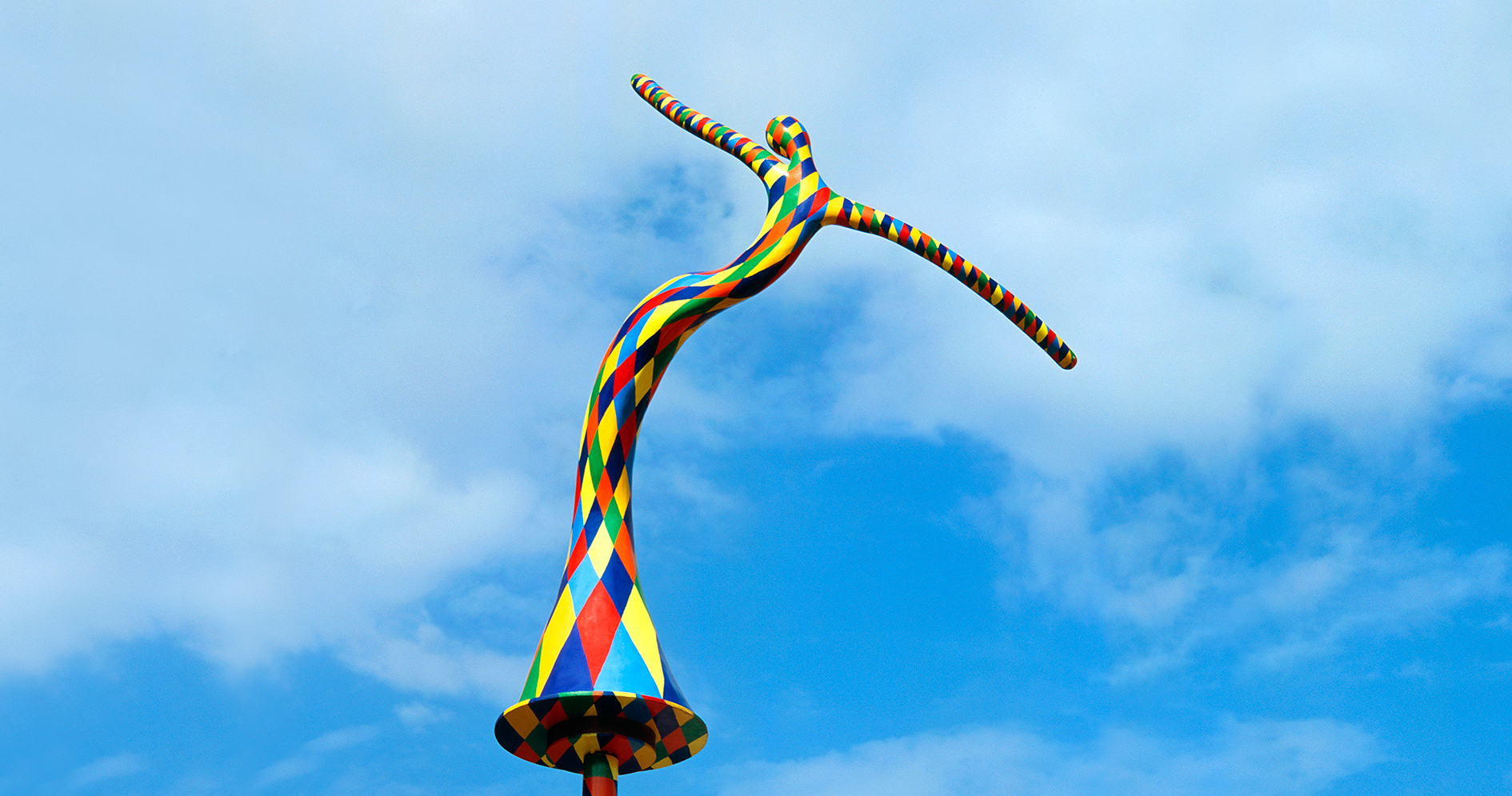
Vassiliki — tall harlequin Dancer figure against the sky, from The City of Games

Education

Literature
Greek, English & American Literature — Kapodistrian University of Athens.
Painting
Drawing & painting at the atelier of Michalis Veloudios, Athens.
Fine Arts
Painting and sculpture at the Fine Arts School of the American University of La Verne; post-graduate studies in History of Art at the same institution.
Italy
Painting and sculpture with Nicolas Carone at the International School of Arts in Italy.

Awards & Honours

1972
1st National prize in creative writing for students.
1974
1st National Cultural prize for students in painting, for the political-protest work “24 eyes and a tank”.
1992
Honoured as a young artist by Jack Lang, Minister of Culture of France.
2006
Prize for the best woman artist of the year in Greece.