Texts · Critical Essays
Seven critical essays, written between 1996 and 2004 by Pierre Restany, Eurydice Trichon-Milsani, Damien Sausset and Eleni Athanassiou — on the cross, the harlequin, the City of Crosses and the City of Games. Read each in full below.
Contents
Pierre Restany · 1998
The cross is one of the oldest symbols of the presence of man on earth and Ms Vassiliki uses it as the basic element of her art.
In Athens in 1998, they are people who deny to Ms Vassiliki her fundamental right, the use in her work of the most humanist symbol of mankind.
Such an attitude reveals a surprising narrowness of mind in a land which pretends to have invented democracy and given birth to individual freedom of expression.
Pierre Restany
Paris, April 13, 1998
Eurydice Trichon-Milsani · 2004 · Texte français
C'est à cette phrase que je pense lorsque j'essaie d'embrasser du regard l'oeuvre complexe et enveloppante “de Vassiliki. L'artiste grecque appartient certes, à une autre génération que le ténor de l'art américain. Depuis déjà des dizaines d'années les avantages du grand format et l'euphorie qui en découle ont complètement conquis artistes et public. Mais ici la dimension ne concerne plus un pan de mur ou même la salle entière d'un musée. Grandiose et populaire, l'oeuvre de Vassiliki embrasse la foule et pénètre le coeur, le faisant vibrer. Pourtant malgré sa dimension, cette oeuvre garde son caractère intime, s' adressant à tout un chacun en particulier. Son exubérance et son accessibilité font que son spectateur se l'approprie immédiatement, sans difficulté, et son action sur lui persévère doucement et longtemps jusqu'à l'entraîner vers une jouissance contemplative. Vassiliki a réalisé ainsi, peut - être sans le vouloir- le rêve d'une autre femme artiste, de nombreuses années son aînée, dont la fraîcheur d'esprit fait autorité encore aujourd'hui :
Sonia Delaunay qui fut la première à désirer faire déborder l'harmonie et la gaieté de ses toiles bien au delà du châssis et à recouvrir tissus, vêtements et automobiles de ses fameux contrastes simultanés.
Chez Vassiliki l'orphisme chromatique ne se répand pas sur les objets du quotidien. Sa couleur, primordiale, est l'enveloppe unificatrice d'un monde à part, monté de toutes pièces, d'une cité magique où le public connaît une immersion régénératrice le conditionnant et le retenant comme par sortilège.
Vassiliki arrive donc à conjuguer l'espace contemplatif d'un Rothko et le lyrisme bienfaisant de Sonia.
A ces deux références s'ajoute une troisième. On ne peut pas ne pas signaler les affinités de l'art de Vassiliki avec celui des op-artistes , Agam , Sotto , Vasarely. Pourtant on s'aperçoit vite que le propos de Vassiliki est tout autre. Elle emploie certes quelques - uns de leurs artifices - le rythme, la couleur, la musicalité - mais les artistes op se contentent de quelques jeux visuels attrayants et irritants, assez superficiels, tandis que chez elle la répétition excessive et systématique d'un motif géométrique n' en fait qu'une petite part d'un projet dont l'ampleur comporte des paramètres bien plus intéressants.
Le fait que quelques-unes de ses sculptures, les cyclistes par exemple, ressemblent à de grands jouets exubérants permet encore une dernière association. On pourrait les comparer à quelques figures de Niki de Saint Phalle , en particulier à celles qu'on rencontre dans la seconde partie de son oeuvre, celle des fontaines et des constructions monumentales réalisées avec Tinguely. Pourtant, dans l'oeuvre de Niki, quand on ne trouve plus la critique sociale de ses débuts, les figures isolées relèvent d'un esprit ludique et purement décoratif. Par contre l'oeuvre de Vassiliki ne peut pas être observée “ en pièces détachées “. Elle forme un tout. Par ailleurs, libérée de toute revendication conditionnée par le social, cette oeuvre est toute profondeur et enchantement, invitation au voyage, appel pour se détacher des contraintes du quotidien et se lancer dans une rêverie imaginative...
Le tout se résume en un nombre restreint d'éléments mis en valeur grâce à une scènographie plus qu'ingénieuse. Vassiliki, comme par le passé dans son oeuvre Cité des croix, a choisi très attentivement ses moyens, limités mais efficaces. Cinq sculptures- figurines, dessinées, modelées et coulées d'abord en plâtre, ensuite en polyester, un motif, le losange, huit couleurs, quelques formes géométriques et un morceau de musique composé par Spanoudakis sur les indications de la plasticienne, voilà l'alphabet très simple de la Cité des jeux. Tous ces éléments ont été adaptés aux contraintes du premier lieu où l'oeuvre fut présentée - à Athènes, dans une usine à gaz désaffectée.
Dans le jardin, des monocycles et des balanciers, sur la place, le carrousel, dans les recoins, des promeneurs en rotation, dans les espaces clos, Le théâtre d'Arlequin et le Temple des couleurs. Un univers soudé, cohérent, sensationnel, offert au spectateur pour l'envoûter, le guider dans le labyrinthe au coeur d'une histoire qui deviendra la sienne..
La Cité des jeux n' est pas à proprement parler une oeuvre. C'est un immense environnement, une mise en scène géante extensionnelle, évolutive, une composition formelle sous l'enseigne du losange, le motif caractéristique qu'on trouve sur le costume du personnage le plus ambigu de la Commedia dell'Arte, Arlequin. Ce motif gai, ludique, enveloppe comme une nappe enchanteresse tout ce monde brillant au même titre que la musique, lente, lancinante et dansante mais aussi imbue de cette mélancolie particulière qui hante les lieux de foire, les cirques et les théâtres ambulants, c'est à dire ces lieux hors du quotidien où le spectateur errant cherche à s' échapper dans le rêve.
La Cité des jeux comporte de nombreux éléments en plein air : des figures montées sur un grand monocycle, d'autres qui, debout sur leurs balanciers, s' apprêtent à exercer quelques acrobaties, et d'autres encore, tantôt groupées dans un recoin en train de jouer une scène, tantôt éparpillées aux endroits stratégiques d'un parcours ordonné par l'artiste. Toute cette population qui ponctue l'espace extérieur entraîne à une promenade au cours de laquelle le spectateur va de surprise en surprise et se familiarise avec les formes. Pourtant, toutes ces merveilles, surprenantes pour le spectateur, ne sont là que pour le préparer : l'essentiel se passe dans les deux environnements couverts : Le théâtre d'Arlequin et le Temple des couleurs.
En entrant dans Le théâtre d'Arlequin le motif du losange coloré atteint au délire, On se faufile à travers de gros ballons de toute taille parfois hauts de deux mètres et cette proximité merveilleuse transforme le corps comme dans les récits de Lewis CarolI . C'est au jardin d'Alice qu'on s' égare , où le souvenir de l'enfance se confond avec un sentiment d'émerveillement et d'inquiétude. Après avoir quitté ce champ insolite de ballons on arrive devant une scène dont la dimension nous surprend : son espace démultiplié grâce aux grands miroirs qui l'entourent semble illimité.
Sur cette scène on retrouve les mêmes sculptures en rotation au rythme de la même musique dont on finit par reconnaître les accents felliniens et qui, comme une rengaine désuète, est porteuse d'une triste gaieté. Tout est coloré et en mouvement, tout semble pousser au plaisir. Pourtant une mélancolie en émane, une sorte de nostalgie poétique qui dérange et séduit.
Au Temple des couleurs l'ambiance est différente. C'est une immense nef entièrement tapissée du motif connu. Les lignes croisées traversent et animent follement l'espace, les couleurs, toujours les mêmes, compartimentées, sages et violentes à la fois, bouillonnent. La température monte, le vertige atteint une élévation tantrique. Les voix d'une adulte et d'un enfant récitant des vers parviennent aux oreilles de tous ceux qui, installés par terre, paraissent magnétisés par l'incantation du lieu.
Vassiliki a atteint son but. Elle a piégé son spectateur. Bien que physiquement absente, elle est l'âme qui dirige ses formes, la cadence de ses couleurs aussi bien que les pas de son visiteur, qui finit par faire partie intégrante de son oeuvre.
La réussite de cette oeuvre tient surtout à sa grande unité. Tous les éléments sont disposés de manière ingénieuse, parfaitement cohérente. Les cinq héros de la Cité des Jeux, figurines filiformes et élancées, versions d'un Arlequin réduit à sa plus simple expression, sont aussi de drôles d'anges à peine sauvés de la chute. La perte de l'équilibre, astuce ludique et menace fatale, se révèle un des thèmes essentiels de l'oeuvre. Mais ce qui porte l'idée de la chute à son paroxysme, c'est la répétition. En effet ces mystérieuses figurines, épigones de mannequins de Giorgio de Chirico, tirent leur force de leur dispositif éminemment répétitif. Ces cinq sculptures “déséquilibrées”, figées et en perpétuelle rotation, semées sur le parcours du spectateur sont vite repérées. Prévues, reconnues, elles sont des leitmotiv captant son attention, le mettant dans un état d'esprit très particulier. Le rôle de la musique est aussi très important. Répétitive, elle souligne les impressions créées par les formes et devient vite familière tout en gardant son caractère étrangement inquiétant. Le spectateur reconnaît sans cesse ces ritournelles qui le pénètrent, le magnétisent, le paralysent.
Le troisième élément essentiel de cette étonnante machinerie est le mouvement rotatif. Les roues , le carrousel, les figurines tournent infatigablement, incarnant ainsi un sens de l'infini. L'idée de rotation est aussi inhérente aux objets immobiles. Les tambours qui supportent les figurines, les innombrables ballons roulant malgré leur immobilité, représentent tout un monde tournant autour de son axe. Ce mouvement ne donne pas le vertige. Mesuré, redondant, c'est une danse lente et insistante qui a pour but encore une fois de tendre un filet magique autour du spectateur.
A ces éléments formels il faut en ajouter un quatrième, quasi métaphysique. Le simple fait que ces centaines de mètres carrés de couleur posée n' ont pas été exécutés mécaniquement est troublant. Toute cette surface immense peinte à la main est porteuse d'une vibration et d'une chaleur communicatives. Ce travail quasi automatique qui a atteint la densité, l'épaisseur, l'élan de la prière ne peut que confèrer à l'oeuvre une dimension exceptionnelle. On ne peut pas s' empêcher de penser aux cartes tissées d' Alighiero e Boetti si touchantes et conciliatrices...
Ce travail manuel, attachant par son irrégularité et son intensité, atteint toute son ampleur énergétique dans le Temple des couleurs. Là, grâce au vide, à la couleur et au motif du losange infiniment répété, une énergie telle se dégage que la nef se métamorphose en un merveilleux vaisseau transportant son passager hors du temps.
Il paraît que le titre “Jeux “n' a pas été bien compris. D'ailleurs combien de choses sont considérées comme” enfantines “ et pourtant sont tout le contraire !
J'ai utilisé le mot jeu “, dit l'artiste, “ comme lorsqu'on parle du jeu de la vie. Comment peut-on parler en termes de jeu, de quelque chose qui contient de la tristesse, du désespoir, du risque, le sentiment de la mort... Pourtant on parle du jeu de la vie. C'est dans ce jeu à mille risques que les Arlequins se lancent lorsqu'ils essaient de quitter leur socle robuste pour atteindre la liberté redoutable du vol…
Cette oeuvre rare par son romantisme et sa séduction intemporelle étonne également par son actualité. Plus que jamais nous avons besoin d'échapper au quotidien comme à l'obsession futuriste d'un certain art contemporain.
Vassiliki avec une générosité hors pair nous ouvre le domaine du rêve pour y retrouver mélangés, innocence et mélancolie, joie et réflexion, délire et sagesse. Elle réussit à nous soustraire à l'enfermement et à la routine et grâce à son rêve visionnaire, elle nous incite à risquer le vol libérateur de son Arlequin.
Eurydice Trichon-Milsani
Eurydice Trichon Milsani, born in Athens, lives and works in Paris. She is a doctor in Art History and a member of the International Association of Art Critics (AICA). She has worked for thirty years at the educational services of the MNAM at the Centre Pompidou and has taught Contemporary and Modern Art History at the Sorbonne and at the INALCO (national institute of oriental languages and civilisations). She is also an exhibition organiser, and the author of many articles and books, including Au Musée national d'art moderne and Dufy, both published by Hazan.
Damien Sausset · 2004
Vassiliki's art questions the meaning of the world. The formula is abrupt, strange and certainly rather imposing. And yet, that's what the artist is about: thinking about the meaning of the world! How can art tackle such a fundamental question, which is normally the domain of philosophy? Simply by questioning the contract that man once hail with the universe, his inner world and even his conception of the afterlife. Vassiliki's art opens up the breach, questioning the very meaning of our existence. It is also that movement by which man gains access to a mystery that is beyond him: the mystery of life.
By operating such a reversal, this art opens a new, yawning gap, rich with new meaning. And yet when we see Vassiliki's works for the first time, nothing is immediately evident; we see before us forms, colours and space. The works also give us something that goes beyond our first view. For example, “The City of Games” (2000) shows us a group of coloured figures in a whirling ballet. Nothing is explained or imposed. And though we seem to see some kind of narrative in this assembly of parts, we soon realize that it is no more than a projection of our expectations and our need to always give meaning to something that is put before us. This magic is based on a virtue. It operates without us knowing, distilling in our mind the seeds of a unique experience that opens out slowly, like a plant, blossoming and taking root in our minds. Their substance becomes ours. It is rare for works of art to have such an ability to remove us from the world in order to lose us more completely in ourselves. The magic operates even better in that we were unknowingly expecting such a revelation. The experience is important. It forms the foundations of the special nature of this approach.
How do we speak of wonder? How do we untie the treads of which these works are made and use words to describe an encounter that we know is unique? We can obviously call on the history of art, beginning with the question of the sublime as it was formulated in the 18th Century in romantic circles to then see how Vassiliki's first paintings were very much part of this issue, containing a continual search for a new theism, a call for a spirituality stripped of its tawdry rags and, at last, open to revelation. We could also begin by mentioning a few famous artists: Sonia Delaunay, Annie Albers, Rothko, Barnett Newman and even Ryman's monochrome investigations have something to do with it. It is connected with a high idea of the role of colour, a desire to escape from the usual painting styles, to go beyond them; in short, a conception of what art should he: an activity aimed at transforming man. To be complete, it must also bring out the idea of synaesthesia, that great Western ambition, which, since Wagner, demands that the true artist should he able to encompass every field of creation in his works: painting, sculpture, music, writing, theatre etc. And, since the mid-i 990's, the artist has been trying to achieve this total fusion. ‘The City of Crosses” (1996), “The City of Games” (2000) and ‘The City of Dreams” (2004) all bring together paintings, sculptures and music simultaneously in styles that are often very different, hut which are aimed at totally integrating the various components.
Another possible approach would he theological, then mystical. Crosses, angels, characters in search of redemption; the omnipresence of these emotive figures is not innocent. By using these signs she was able to articulate her own quest for meaning with all the depth of a story to which she had been made particularly sensitive. ‘The Crosses” (1998) was an excellent example of this, simultaneously playing on the distinctive features of a site full of history - Athens and on the ambiguity of the symbol of the cross, once ii has moved away from its strictly religious context. We must not forget thai Vassiliki is Greek. More than anyone else, her culture has been forged from the question of origin, from what forms the unchanging foundation of our civilisation and is therefore the basis of our relationship with the world. Her work exacerbates a latenttension that is never really resolved, between the dazzling nature of ancient Greek thought and the mysteries of the sacred, especially Christian. This tension still, in fact, structures not only our own Europe hut also mankind in search of meaning. Rationality against belief, logical thought against the outbreak of feelings: Vassiliki attempts to take us beyond these simple opposing ideas, showing us in her works that it is all, in the end, just part of the path of history: the history of a God who becomes increasingly absent as our world devotes itself to a deconstructior, of the self.
To understand Vassilikis art, we therefore need to understand a personal history: that personal history that might untie the threads of a life made up of terrible dramas and miracles, a life made up of journeys without a return, of discoveries and disappointments, a life in which a few friends and relatives had the sensitivity — which brought them extreme happiness — 01 staying close to her. Yes, all that might he possible hut its would be totally contrary to her aspirations. Vassiliki's art does not draw its energy from the depths of her life. There are, obviously, sonic connections, hut her work, the way in which she has given herself up totally — one could even say extremely - over the last ten years to art goes far beyond a chronology of events in her life. Vassiliki believes in man. She is still convinced that, whatever he does or doesn't do, feels or doesn't feel, says or doesn't say, man, this strange living being, answers to the world and for the world. Simply put, answering for the world requires a rare delerminalion in a world governed by fiction and the power of the media. Vassiliki's entire artistic undertaking is aimed is to bypass this obstacle by giving those who try the experience the strength to answer for the world, One day, we must write about the reactions of those who discover her works, talk ahoul the happiness of children, their sense of wonder, the way in which they immediately become one wit the sculptures. We should also attempt to classify the behaviour of the adults. One forgets his attaché-case, others, who are feeling deeply depressed, forget themselves for a day, some come back with others, as if they were offering a precious gift for ever.
At the heart of the devices, there was also a key ligure whose potential Vassiliki has continued to explore, even in her most recent works: the harlequin, a character used many times over in “The City of Games'. This Commedia del Arte character, who is both a symbol of a man who makes light of the constraints on the stage of life and a tragic figure, constantly trying to move beyond his social condition before finally removing his mask and showing himself in all the splendour of his being. Today, the mask has disappeared, and, even though certain paintings still show characters without faces, she now prefers to show couples, and even larger crowds.
The men and women of this period have a rather sovereign way of getting out of their depth without worrying about it, a way of walking with a certain assurance on the waters of the world's catastrophe. Vassiliki's art is proof of this. Certainly, the demand for sense is immense. We are on the lookout for signs to light our way. We ask the world to be a living space, shelter, home, privacy and community; we want it to he less tattered and scattered. Like anyone else, Vassiliki knows that there is no longer a world, or what we used to call a world no longer exists due to lack of order, lack of landmarks and direction. Vassiliki admits, without confessing it, that we are living through the end of the world. But, unlike all those right-thinking intellectuals, the end of the world, for her, means something other than just the end of a conception of the world. The world can no longer he credited with significance, and only art has the right to think that way. But thinking that way does not mean interpreting the world, or even re-enchanting it with some piece of magic; it means transforming it. This is why Vassiliki's art is, above all, a questioning… of space. Above and beyond being a series of sculptures and shapes, her works rethink the space that we share, the space which Ic,rms a community. And we are invited to enter that space.
In the past, she had designed this space as a devastated expanse in which there seemed to be no way out other than lucid introspection. “The City of Crosses ' was that kind of space, with its broken mirrors and maze-like trail. More recently, “The City of Dreams” was presented as the achievement of a reversal. The landscapes that she constructs are open and accessible. They are presented as common spaces from which every reconstructs his relationship with himself and others, Instead of setting outthe differences and looking at the world with friendly or critical eyes, Vassiliki is content to construct spaces in which people can make contact. And t is by opening up these spaces, using extravagant, shimmering colours, that she suddenly questions the meaning of the world. We could add that there is also a gesture that both dismisses the gods and calls upon them, as if the stage in our modern tragedy was now empty, as if art has entered where the gods are absent.
But Vassilikis genius is that she has understood that the meaning of the gods is exactly that: to be absent, to always be absent, and to be present by this very absence. Vassiliki remains one of the few artists to carry out a perpetual siruggle against the entropy of the meaning of our world. In each of her works, she joyfully tempts us to keep our fears at bay and hold back, for just a moment, the image of the terrible finality that awaits us: death.
Damien Sausset
Eleni Athanassiou · 2000
In her paintings as well in her installations, Vassiliki has documented the productive dialogue between art and life through everlasting cultural and religious figures and symbols. Her work as a whole is defined by coherent, autonomous thematic evolutionary units, and it forms a creative polyptich, which reflects genuine existential awakenings and a philosophical contemplation on man and the divine with a clear reference to the cross.
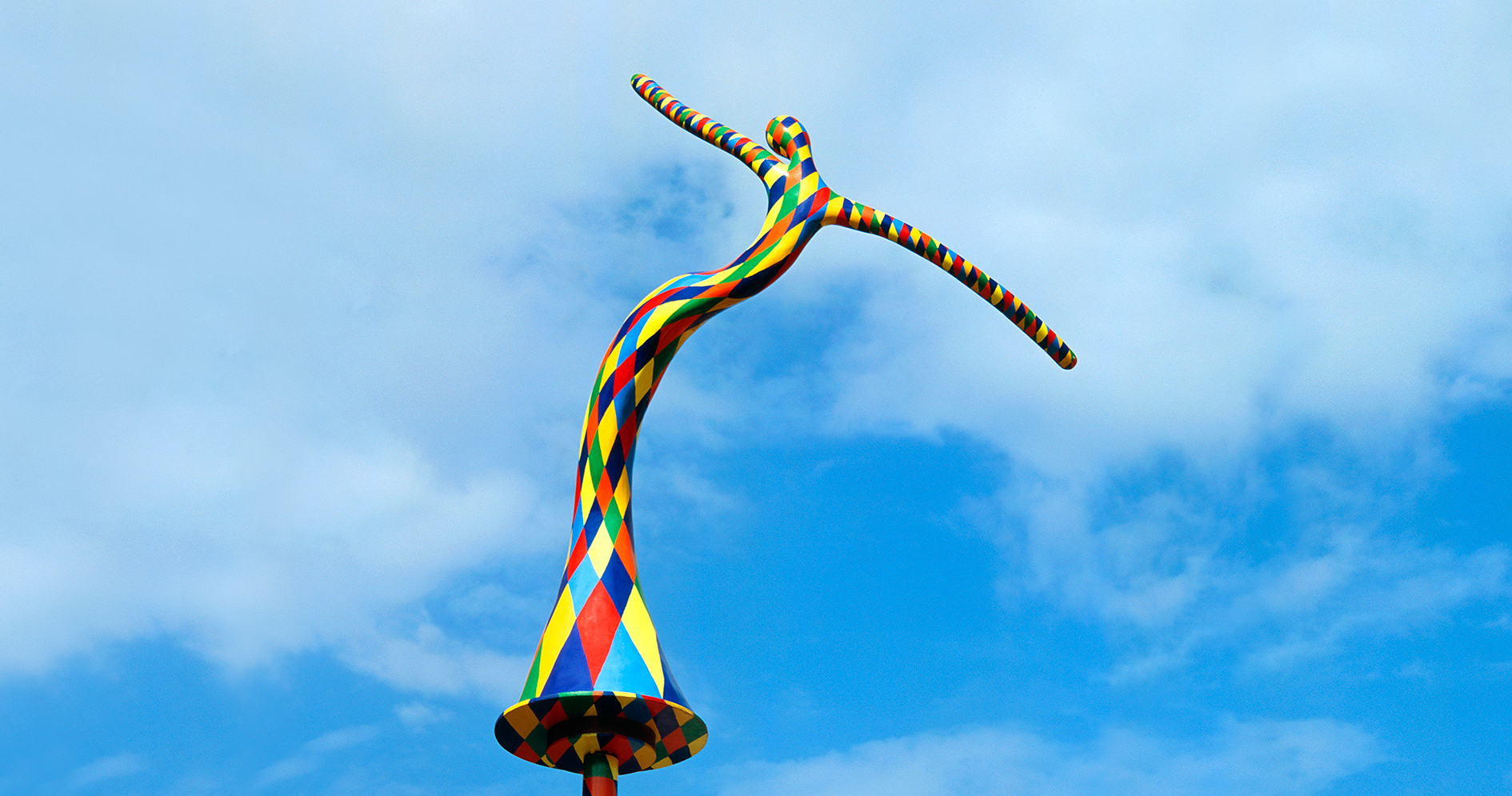
Her new installation City of Games is composed by a plethora of colors, shapes and endless arabesques flying into the air and outlined by the figures of Dancers, Acrobats, Guards and the Harlequins -the dominant figure of the City- through swings, the wheel, balls and other machine-made divices. Following the inspired Stavroschimites (cross-shaped figures), referring to the form of virtue through its embodiment in the human figure, Harlequins emerge as a key symbol of the artist's approach toward life, death and the divine.
A magestic «stage» with all the necessary paraphernalia promising the trip to the magic world of imagination through the unknown, behind which lurks the danger of balance, the City of Games is an independent, integrated and self-sufficient environment. It carries along its visitors due to the grandness of its extension and the indescribable game of the senses.
The characteristic multi-colored diamond shape costume of Harlequin, the protagonist of commedia dell' arte, is the primary motif of the City of Games . Dressing up the walls of its surroundings, the diamond shape evolves into an enigmatic game of color combinations that is based on the so-called optical experience and perception} The color tones, the combinations as well as the diamond shapes are almost never perceived to be the same. This differentiated optical perception is due to functions and stimuli of the human brain. A game of dizziness and intoxicating «hypnotism» accompanies the acrobatic attitude of the brain this time.
From social criticism and existential wanderings to metaphysical speculation; from the writings of the Middle Ages, the Renaissance commedia dell' arte, the 19 th century vaudeville, and lonesco's theatre of the paradox, Harlequin never stopped stimulating the imagination, and feeding the charm of mystery Harlequin's enigmatic and continuously changing character, the persona who stood against social corruption and the paradox of life since the 16 th century, is being revived in theatre, dance and the fine arts. In Vassiliki's work it plays a distinguished role, which also defines a certain standpoint regarding life.
Walking the tightrope between good and bad, serious and funny in order to conquer life is absolutely dangerous behavior, which entails tragic irony. A tragic figure, Harlequin is conceptually defined by the vivid antithesis between his colorful, entertaining appearance and his exceptionally serious psyche, demonstrate the fragile balance of his course and role, and alluding to the ontological dimension of the artist and the actor.
Perhaps the most suitable comment on Harlequin's psyche is the one given by Charles Baudelaire when referring to actors, that behind their triumph and hypocritical talent, actors hide a desperate soul. «How week and awkward, even comical this traveler but lately so adroit.» 2
C.Baudelaire does not limit himself to the actor, but broadly refers to artists within the context of creation, and he attributes to them the dimension of a double identity or dual entity The importance of this dimension is exceptional, considering the particular relation between artists and their works as well as their fragile balance within the world.
Harlequin became once more one of the most popular figures in the cultural life of the 20 th century, not merely with regard to history and the evolution of theatre, but as a archetypal figure: a personal, and at the same time impersonal figure, transcending psychology and history, referring to artistic archetypal figures.
Vassiliki was inspired by Harlequin's aura, which she perceives as a depository of energy with a dual substance; she also perceives it as a challenge for creation, and a dangerous, yet appealing fascinating standpoint toward life and death, due to the interaction and effervesce of the opposite powers of the soul. For Vassiliki the depiction of Harlequin and of the notion of the paradox, which gives life its tragic substance through the arts, has been a challenge of expression.
The comic and, at the same time, tragic basis of the absurd through pain and human sacrifice, a model of which is Christ's sacrifice, is perceived by the artist as a moving power for the research on Harlequin and his world. Within the Harlequin's figure, man sees the struggle of the soul against the martyrdom of its embodiment.
Similarly, Harlequin's tragic figure, receiver of misfortune, appertains the sacred sacrifice. In this respect, Vassiliki's Harlequins maintain the primordial bonding of every living organism with death. Their cross-shaped figure is a clear indication of God's awakening power through Christ's sacrifice on the cross.
The cross-shaped opening of their arms clearly demonstrates the inevitable human pain. However, the pain of Vassiliki's Harlequins is not a pathetic, stoical, and without complaint outlook of facing things. On the contrary, signifies an excessively energetic, positive temperament. At the same time, the arched poses of their bodies and hands formulate coordinating complexes within the surrounding space by adopting opposite directions.
The faces of the Dancers, Guardians, Acrobats and Harlequins -stripped of expression due to their invisible characteristics- are formed by smooth, sleek surfaces with intense contours. The circle, which is clearly a depiction of the world, has a semantic significance for the circle of life.
At the same time, the bodies remind us of the characteristic circular movement of the creation, birth, and formation of soulless substance into a living entity. Tall and thin bodies, fragile, innocent, naive, dangerous, constantly moving and seeking to achieve and maintain their balance with wide open arms, are the acrobats of life and soul. They constantly sense around their bodies an abysmal and mysterious void, the unknown that they desire to explore.
This void, that we could imagine as the universe itself, the beyond, is where they derived, the ethereal mass by which they are joined, and in which they become assimilated. Each one of them takes on a masterly dancing pose, perhaps due to the perpetual circular movement of the bodies and of their spirit. A theatre group or members of a ballet, the Harlequins of the City of Games acknowledge their collective presence by forming a community of angels of life, representing love.
Harlequin's perpetual movement, awakening wide open embraces, and welcoming gestures are symbolically found between sky and earth, life and death, thus referring to transitions, constant evolution and exceeding situations, feelings and limits. Maintaining their contact with the universe signifies a primordial standpoint/approach with regard to the circle of life.
Relating to danger, their fragile balance drives them close to death, the traces of which become integral parts of their being. However, they exorcise it with love. Vassiliki's Harlequin is not the diabolic grotesque Ellekin, the animal bestowed to us from the Middle Ages, the Satyr and Selene in the pagan world order of antiquity He is the sublimated angel of virtue. In order to be purified, he played the game of Vice and Virtue and subjugated his primitive instincts. From Dionysus' comrade he becomes Apollo's priest and Light, while being Mercury he is a tightrope walker from life to the dark paths of Hades, and from the sunbathed earth to the bright and opalescent moon.
Guillaume Apollinaire has the answer to the question of Harlequin and Mercury when he detected their opposite transitions from good to evil, where they managed to balance. This is how he explains the birth of various aspects of art such as theater and dance. 3
Traditionally Harlequin, like other characters of commedia dell' arte would travel to far and exotic places, occasionally beyond the limits of earth, peronifying glorious ancient deities and heroes. «Aggressive and jaunty clowns, I believe you will leave your various troubles, daily woos, and poverty in the cloakroom, for it is decreed that clowns can fly to seventh heaven, abandoning the sad winters of earthly life, to satisfy their taste for the imaginary. All you need is patched-together, showy costumes, Baroque decor, and footlights in order to feel lighthearted and to see blossom around you an artificial and charming world.» 4
In the book illustration of the French play Harlequin, Gallant Mercury (1682), in which he plays the role of an ancient Roman god, there is a depiction of an eagle, the wings being wide open, coming down from the moon to the earth. 5 Mercury's (Hermes') magic and flexible nature matches perfectly with the constantly changing persona of Harlequin, who often becomes the subject of metaphysical speculation and research.
Harlequin develops subsequent layers or masks of flesh, which ensure him, except of a physical acrobatic flexibility, an indescribable behavioral flexibility. These layers are worn successively, that is, one on the top of the other, until he attains the mask of the Emperor of the Moon 6, the most representative mask, an alter ego of his personality. Vassiliki perceives all these masks as the undertaking of incompatible standpoints in life, a walking on thin ice, being the achievement of a sensitive balance and paying its price.
It deals with the enigma of Harlequin... It pictures his comrades and his natural surroundings - the theater stage of the world playing the theater of the paradox... A fête, which stimulates the senses as well as the mind, and is supported by spontaneity, «curiosity» and improvisation, Vassiliki's City of Games develops a semantic reference to the revealing notion of tragedy, irony and sarcasm of life.
With a clearly light, full of emotion and tenderness interpretation of the relation between internal workings and external conditions, the sculpted works of the City revive the allegory, the capricci and scherzi di fantasia of the 18 th century Venetian theatrical tradition. The Harlequin, the Dancer, the Acrobat and the Guardian are our alter egos. They epitomize the tragedy of comedy, and they remind us of the melancholy upon returning to reality.
Eleni Athanassiou — Art Historian
Endnotes
1 David M. Rosenthal (ed.) The Nature of Mind (New York: Oxford University Press, 1991), 417
2. Charles Baudelaire. Poems (New York: Alfred A. Knopf, 1993), 19
3. To . . ( : , 1991),
4. Lynne Lawner. Harlequin on the Moon. Commedia dell Arte and the Visual Arts (New York: Harry N. Abrams), 169-170
5. Ibid., 25
6. Martin Green and John Swan. The Triumph of Pierrot (University Park, Pennsylvania: The Pennsylvania State University, 1993), 194
Eleni Athanassiou · 1997
Expressive and at the time frugal are some of the concepts formed in the visitor's mind while facing the “ Stavroschimites ” figures who, being members of an alive primordial society of chosen ones, transmit him/her the spirituality accompanying every state of psychological exaltation and intellectual renaissance.
Faithful to the aesthetic interpretation of the cross on which countless smashed pieces of mirror entrap and reflect the idol, Vassiliki transforms the image but not the shape. With stavroschimitises (cross-shaped human females) and stavroschimites (cross-shaped human males) the artist revives the intellectual charging of the symbol of the cross infusing it with life, and she adapts its shape to the human figure offering her the cross' fearful substance.
With a distinctly direct interpretation of symbolism in which the main protagonist, the cross coexists, moves along and suffers with the object of its symbolism, man-human being, Vassiliki communicates the gradual and painful way to the attainment of an intellectual and emotional state of being that does not succumb to relativeness and subjectiveness. This way is nothing but the process that would lead to the achievement of the original form of human creation treated earlier in the “City of Crosses”.
However, the City was an intermediate stage, a step in the evolution of this process, that was vividly marked by the active interaction of the crosses, urging an internal discourse that would lead to the achievement of human integration. Stavroschimitises and stavroschimites are here to announce the arrival at the final stage of this process, and having accomplished that they serve as an accessible role model for the claimants of the “universal” intellect”.
A process that marks Vassiliki's personal evolution and aesthetic journey, it originates with the contribution of the crosses (an object with symbolist implications), and it ends in the expressive presence of stavroschimites (the sculptural expression of alive and active beings) who were purposely selected to symbolize the materialization of the personal attainment of the psychosomatic condition and notion of the concrete internal totality.
By being humanistic, once more, Vassiliki's art brings to a direct contact the exterior (shape, object) with the interior (emotion, subconscience, idea), and it transforms their relation into a mental interactive experience in which the visitor becomes initiated by stavroschimitises and stavroschimites, who at the same time encourage him to become involved to an introspective, self-knowledge leading procedure. In his contact with their community the visitor-participant realizes that those figures are his natural environment since he could very well be identified with their position, role, and existence.
Bearing the shape of the cross the members of the stavroschimites' community are in fact those beings who through their standpoint in the complicated journey of life they justly become the last “citizens” of the earthy paradise. This is the embodiment of the perfect society which the “City of Crosses” dealt with in a theoretical level while the community of “ Stavroschimites ” practically embody it.
Soldiers of a holy crusade, “ Stavroschimites ” are becoming compatant battalions in Vassiliki's idealistic, existential wanderings. Instead of borrowing the shape of the cross they act as self-shaped creations who grope for the knowledge of the divine substance. They bear within themselves the dynamic interaction of real beings, reflected from their correlation which is primarily characterized by spiritual communication, companionship and solidarity.
The uplifting and inviting opening of their hands-arms reflects their mystical communication with the immaterial world of Creation aiming at the attainment of truth which leads to the purification of soul. Actually, this pose declares an intellectual ecstatic state which matches Maimonides' encouragement to perfect the human intellectual power through philosophy and dedication in the world of intelligibles in order to ensure the redemption of the soul, thus providing a portrait of human perfection. 1
Adopting the Platonic approach that no object in nature is other than the idea signified 2 Vassiliki functions on the basis of an idealized, existential view with regard to artistic creation, wich considers it as the outcome of the synthesis between the subjective and the objective meaning of the source of inspiration accompanied by an intense philosophical contemplation. 3
An outcome of the interaction between artistic inspiration and philosophical contemplation, “ Stavroschimites ” are the translation, into a special language, of a spiritual given, which is to say the least, a fragment of Vassiiliki's spirituality, to say the most her entire spirituality plus the spirituality of the idea represented by them.
Eleni Athanassiou — Art Historian
Endnotes
1. Moses Maimonides, Eight Chapters in Ethical Writings of Maimonides , translated by Raymond Weiss and Charles Butterworth (New York: New York University Press, 1975), 77.
2. Patricia Townley Mathews, Aurier's Symbolist Art Criticism and Tehory (Ann Arbor, Michigan, 1986), 33.
3. Ibid., 66
Eleni Athanassiou · 1996
“The point of view where he sees things from is a point from which this and that, yes and no, are not faced separately one from the other. This point of view is the Axis of Law, the immovable center of a periphery at the edge of which revolve all relativeness, distinctions and individualities and from there only Infinity is faced, which is neither this nor that, neither yes or no. Looking everything from within the unchangeable original unity or from such a distance so that everything is merging in one, this is genuine spirituality.”
Chuang ChouI-Ching, chapter 2
Profoundly homocentric Vassiliki's art signifies the continuation of a route dedicated to the mystery of Being through symbolism. In the devout environment of the City of Crosses the artist combines her artistic proposal with the everlasting concern of inner balance, and man's position in the universal whole.
The relations among the crosses give a new substance to the interaction between the microcosm (man) and macrocosm (universe). Their opposite directions, course and trends form the three-dimensional substance of the City's environment, a system of co-ordinates within the space.
Space, the accumulation of man's potentialities and of those of the universe is defined by the vertical and horizontal axes-in comparison with the surrounding environment as well as among them-which adopt opposite directions: North and South, East and West, Zenith and Nadir, left and right.
Their behaviour confirms the validity of the Platonic theory of “correspondences” with regard to the elements of subconscience and those of conscience as well as those of the macrocosm and the microcosm, which became popular again in the philosophical writings of the 19 th century theosophist, and influenced the art of symbolists radically.
The crossing of the vertical with the horizontal arms, the meeting point of opposite directions, and the origins of absolute and irreversible Truth impels the artist to use the cross as the ultimate point of artistic expression. In her art the center of the cross represents reconciliation, withering of conflicts, cooperation of all powers that compete with each other forming a new data which is ultimately going to be replaced by a new synthesis.
In the center of immutable unity and truth lies the absolutely balanced individual, an outcome of a process of differentiation, opposition and struggle against the enemies within himself, that is, those powers which oppose his internal balance and unity. The aim of this struggle is reconciliation rather than annihilation.
Man's ultimate goal, as it is expressed through the dynamics of the crosses is the struggle which aims at accomplishing the unity of all conflicting powers: unity of thought, unity of action and unity of thought and action. The attainment of inner unity is only achieved by the individual who overpowers any relativeness, and it represents absolute balance and truth, his final redemption.
In the City of Crosses the reality of a dream or a symbol is expressed indirectly through a mixture of materials, shapes and proportions, out of which emerges the final revelation; a revelation of the breadth and the depth of the soul itself which signals the beginning of its redemption.
Vassiliki's symbolism forms an artistic dogma which borrows from religion but is purposely differentiated from the mystery of religious fear and dogma. The City implies that it is the outcome of the experience deriving from the dominant element of the human world, the continuous change of the Hegelian dialectic of thesis, antithesis, synthesis.
Paul Gaugin, one of the forerunners of symbolism, was an advocate of the idea that art is a notion of an abstract content formed in connection with functions of the subconscience with an emphasis on the process of creation rather than the final result.
According to that, the City of Crosses represents a synthetic process of the subject with the idea and geometry with materials aiming at activating emotions, and at awaking the issue of existence. Based on emotion and instict rather than logic or any intellectual function, the environment of the City of Crosses is an everlasting proposal for self-exploration which leads to a redefinition of our priorities through its directness.
Eleni Athanassiou — Art Historian / Curator
Eleni Athanassiou · 1996
Symbolism, which was first initiated in painting at the second half of the 19 th century, found a particular expression in the art of Nabis (in Jewish prophets).
The Nabis was a group of French artists, who, based on the philosophical tradition of mysticism, treated art as the medium through which they should transmit their position about the existence of a “reality” that is independent of the physical substance of the individual and his ability to communicate with the outside world through his senses.
Vassiliki, like the symbolists – Nabis, embraces the philosophy of experience through intuition and instinct, the highest form of reality which Plato first defined as Idea in Timaeus . The Platonic as well as the Hegelian dialect define Idea as a reality of a transgressive nature. The primary concern of the artist's work is to provide the spectator with messages and to initiate an introspective. Through a combination of colors and lines her art stimulates and makes accessible various stages of human soul.
The artist uses color without subduing it to any type of conventional rules, and she rejects any reference to place and time. By doing that, she succeeds in adapting the theme and the idea that is connected with its materialization with form and color, so that her art reflects the mystery that accompanies every esoteric experience. At the same time, as far as the picture is concerned, the abstraction of the background contributes in the creation of a highly spiritual atmosphere.
Her work is of a para - religious nature distinguished by the cross, angels an bloody wreaths, all of which are religious symbols that are not used in order to attribute a religious significance in her works.
Vassiliki borrows from religion, in this case Christianity, symbols of a certain significance and relation with the history of religion. Her goal is to have a substantial expression which has been, as it presently might be for some of us an expression of the subconscious. The immaterial angelic figures emerge from the unknown in constant motion outlining pictures of the human soul.
In the absolutely atmospheric and emotionally-charged City of Crosses , each of them adopts a different position and direction, loaded with burdens of various eras. Twenty one crosses carry twenty centuries of human history and evolution as well as the one that we are about to cross. Therefore, we are faced with a new world order which is everything but steady; on the contrary, its ever-changing nature creates a plethora of data of a limited validity with regard to time and place. This moral disorientation is reflected to the fully-anguished presence of Christ, who seeks a reference point and the beginning of man's redemption.
The Cross, eternal symbol of martyrdom and redemption, joins the earthly world with the universe, and embraces humanity regardless its diversity. Within Vassiliki's art it exists as a unifying power which appeals to dissimilar, if not opposing powers.
Based on the motion that each and all the elements of the earthy world correspond to those of the universe, the artist brings together the microcosm (man, earthy world) with the macrocosm (universe).
The theory of “correspondence” was originally met in Plato's Timaeus and later in all 19 th century mystical writers, such as Eliphas Levi, Emanuel Swedenborg and Charles Baudelaire, who developed a theosophical approach that influenced symbolists, particularly the Nabis. Each of their representatives such as Odilon Redon, Eduard Vuillard, Pierre Bonnard, even Paul Gaugin adopted a personal symbolic expression whose primary goal was the reflection of “reality” without a certain representational form but rendered convincingly with an appropriate composition of colors and lines.
Indirectly human-centered with regard to the theme, the messages, and its inspiration, Vassiliki's art surpasses the limits of time. It is not only the reminding of the essential function of the subconscience as an influence to human behavior in general, but the sensibility of the artist with regard to human dignity which urges her to protest.
Her work, discharged of any conventionality and subjection have an original and authentic inspiration. Its strength is located in its ability to sensitize a part of out active existence – the subconscience. Each of her works is a familiar experience; if not, Vassiliki suggests that is should be. Similarly, she urges us to search for the truth and to return to authenticity. The spirituality and intense psychism that she reflects aim at succeeding all these. They are the artist's moving power and our challenge for the future.
Eleni Athanasiou — Art Historian / Curator